If you've had a conversation with your Google rep recently, there's a good chance AI Max came up. It's Google's latest automated feature for Search campaigns, announced at Google Marketing Live in May 2025 and rolled out globally through the second half of last year. The pitch is compelling: more conversions, better reach, smarter targeting, all from a single toggle.
We've been watching AI Max closely since the beta, testing it across client accounts and paying attention to what independent researchers are actually finding. Our view is that the platform has genuine potential, but the gap between Google's marketing of AI Max and its real-world performance, particularly for lead-generation businesses, is significant enough that marketing managers need to be across this before their agency enables it on their account.
This post covers what AI Max actually is, how it differs from Performance Max, what the independent data shows, and our current position on when it makes sense to use it.
What AI Max actually is
AI Max for Search is not a new campaign type. It's an optional feature layer you can enable on top of existing Search campaigns. Where Performance Max runs across all of Google's channels, AI Max sits within Search specifically, using Google's AI to expand targeting beyond your existing keywords, dynamically generate ad copy, and select landing pages it thinks are most relevant to each query.
The three core components are search term matching (finding queries beyond your keyword list), asset generation (creating ad copy variations in real time), and URL expansion (sending users to pages Google determines are relevant, which may not always be the page you intended).
Google's promise is a 14 per cent lift in conversions at a similar cost per acquisition. For campaigns still relying heavily on exact and phrase match keywords, they cite up to 27 per cent improvement. Those numbers come from Google's own internal beta data, and as we'll get to, the independent results tell a more nuanced story.
How it differs from Performance Max
PMAX and AI Max solve different problems and operate in meaningfully different ways. Understanding the distinction matters, because the failure mode for each is different.
Google Ads | How it works |
Performance Max | A standalone, omni-channel campaign type. Runs across Search, Display, YouTube, Gmail, Maps, and Discover simultaneously. Requires creative assets across formats. Operates as a near-complete black box, with limited visibility into where spend goes and why. |
AI Max for Search | An add-on feature for existing Search campaigns. Stays within the Search network. Expands keyword reach, generates copy, and selects landing pages using AI. Maintains more of the reporting and control structure of traditional Search campaigns. |
For lead-generation businesses, PMAX has been the more widely used of the two, partly because Google has pushed it aggressively and partly because the early results in some accounts were genuinely strong. Our experience is that PMAX can work well, but only when the conversion data feeding it is clean and ideally enriched with downstream CRM signals. Without that foundation, PMAX optimises for whatever it can measure, which often means optimising for form submissions rather than qualified leads.
What the independent data actually shows on AI Max
Google's internal figures are one data point. A more useful one is the independent analysis published by Smarter Ecommerce, which examined more than 250 campaigns after the general rollout. The median revenue uplift was 13 per cent, close to Google's claimed figure. The median cost per acquisition increase was 16 per cent. The ROAS range across accounts stretched from positive 42 per cent to negative 35 per cent.
That last number is the important one. A range that wide tells you AI Max is not a consistent performer. It's a variable one. An average that looks reasonable conceals significant downside risk, and the accounts that went backwards did so materially.
One of the specific structural problems the research identified: up to 63 per cent of the time, AI Max's keywordless expansion was not finding new territory. It was recycling queries that the existing keyword structure was already capturing. Google frames the expansion as additive. In practice, it was often duplicative, consuming budget without producing incremental results.
A separate four-month head-to-head test by practitioner Xavier Mantica found AI Max finished last across the comparison. It cost 128 per cent more per conversion than Phrase Match and 91 per cent more than standard Exact Match. His conclusion was direct: the additional cost was not justified by the additional volume.
What this looks like in a real account |
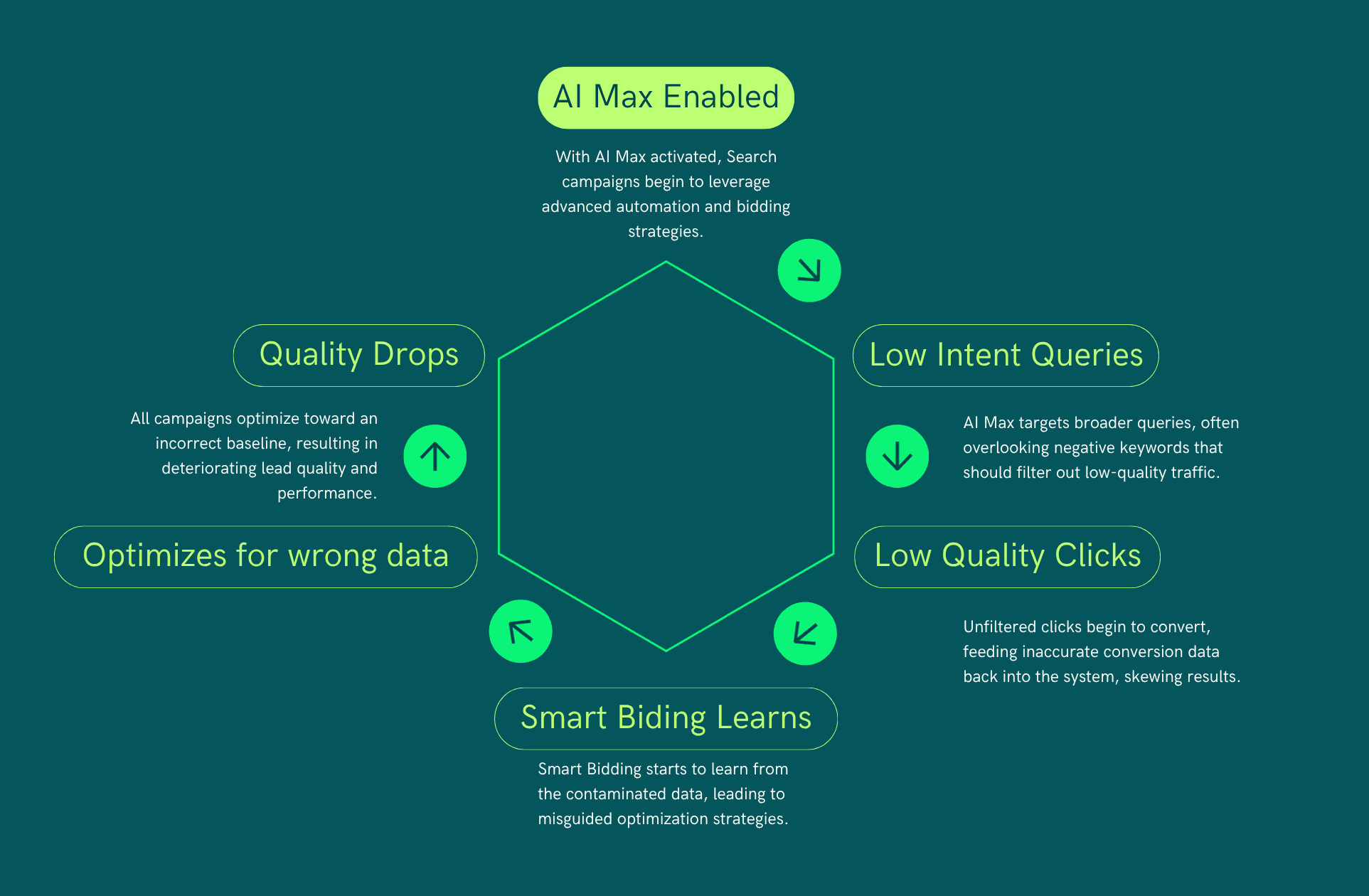
AI Max is enabled on your Search campaigns. It begins expanding to queries beyond your keyword list, many of which are lower intent and what's worse is, we have found it ignores your negative key words and continues to bid on them even after they had been excluded previously. These clicks convert at a lower rate, but they do convert, so Google's system counts them. Your Smart Bidding strategy sees rising conversion volume and lowers bids, interpreting this as success. Your actual cost per qualified lead rises. Your reported CPL may look flat or even improved. The misalignment between reported results and business results compounds over weeks and months. |
The conversion data problem is the real issue
The concern we come back to most often with AI Max isn't the feature itself. It's what enabling it does to the conversion data that's driving the rest of your account.
Smart Bidding learns from every conversion signal in your account. If AI Max is introducing a volume of lower-intent, lower-quality conversions into that data pool, the bidding algorithms across all your campaigns start calibrating toward the wrong baseline. Your other Search campaigns, your PMAX campaigns, all of them are now learning from a contaminated data set.
This is why we describe it as a data poisoning problem. It's not always immediately visible in the numbers. It tends to show up gradually, as lead quality drops, sales team conversion rates decline, and the gap between reported marketing performance and actual revenue starts to widen. By the time those signals are obvious, the learning period has already done its damage.
Our current position on AI Max
We're not telling clients to avoid AI Max permanently. We think the technology will mature, and there will be accounts where it makes sense. But our default right now is not to enable it, and that position is based on what we're seeing in accounts, not on instinct.
The one scenario where we'd consider using it is if the account has a specific conversion goal that is genuinely isolated from the conversion data driving other campaigns. Meaning the conversions AI Max would be optimising for are not shared with, and cannot contaminate, the signals your PMAX or Search campaigns are learning from. In practice, that's a fairly narrow set of circumstances. For most lead-gen businesses running standard account structures, that isolation is difficult to achieve cleanly.
PMAX, by contrast, is still producing better results in our accounts when it's set up correctly. The prerequisites are non-negotiable: conversion tracking needs to be accurate, conversion events need to represent real business value, and where possible, CRM data should be flowing back in to tell the algorithm what a good lead actually looks like. When those conditions are met, PMAX is a genuinely powerful campaign type. When they're not, it has the same problems as AI Max, it just takes longer to diagnose them.
Questions to ask your agency about AI Max |
Is AI Max currently enabled on any of our Search campaigns? If so, how is it separated from the conversion data feeding our other campaigns? What conversion events is it optimising for, and are those the same events our PMAX campaigns use? What does our search term report look like since AI Max was enabled, and are the new queries relevant? Can you show me lead quality data since activation, not just lead volume? |
What to do with this if you're overseeing an agency
The most useful thing you can do right now is ask your agency specifically whether AI Max is running in your account and, if it is, what their rationale was for enabling it. A good agency should be able to explain clearly how the feature is isolated, what it's being measured against, and how they're monitoring for data contamination effects.
If the answer is that it was enabled because Google recommended it, or because the account manager thought it was worth testing, without a clear data isolation strategy, that's worth pushing back on. Not aggressively, but specifically. The question is not whether AI Max can work. It's whether the conditions are in place for it to work without degrading the rest of your account.
Google will continue rolling AI Max out more broadly through 2026, and there's a real possibility it becomes a default-on feature rather than an opt-in one. Staying across this now puts you in a better position to have an informed conversation with whoever is managing your campaigns.
Related: If you'd like an independent review of how your account is structured, our audit covers campaign types, conversion setup, and data quality: Book a free audit