
When a Google Ads account is underperforming, most people look at the same things first. Click-through rates. Conversion rates. Landing pages. Cost per lead. These are reasonable places to start, but they all share a common assumption: that the clicks coming into the account are at least reasonably qualified to begin with.
In our experience auditing accounts across a wide range of lead-generation businesses, that assumption often doesn't hold. A significant portion of ad spend, anywhere from 20 to 60 per cent depending on the account, is being consumed before a useful click is ever recorded. The budget disappears into queries that were never going to convert, audiences that were never a fit, and structural inefficiencies that compound quietly over time.
The frustrating part is that this kind of waste is largely invisible if you're not looking in the right places. Your dashboard might show a reasonable cost per click and a healthy impression share. But underneath that, the account is paying to be seen by people who had no intention of buying, in auctions it had no business entering, with ads that were actively attracting the wrong audience.
This post covers the six most common sources of pre-click waste we find when we audit accounts. It's structured so you can use it as a starting point for your own review, though as you'll see, several of these issues require more than a surface-level look to diagnose properly.
1. Keyword strategy built around volume rather than intent
Keyword selection is where most account problems start. The temptation, particularly for businesses new to paid search or working with agencies that report on impression share, is to go broad. More keywords means more coverage means more opportunity. In practice, it usually means more irrelevant traffic.
The keywords that drive the most impressions are rarely the keywords that drive the most qualified leads. A law firm bidding on 'lawyer' is competing for a term so broad that the searcher could be researching a career, looking for a legal drama on Netflix, or trying to understand a document they received. A law firm bidding on 'family lawyer Melbourne consultation' is reaching someone who has already decided they need legal help, knows the area of law, and is ready to take a next step.
High-intent, specific keywords typically have lower search volume and higher cost per click. They also typically convert at a significantly higher rate and produce better-quality leads. The economics almost always favour specificity over volume, but building a keyword strategy around intent requires a genuine understanding of how your buyers actually search, at different stages of their decision process.
The diagnostic question is not how many keywords your account contains. It's what proportion of your spend is going to keywords that match the intent of someone who is actually in the market to buy.
What to look for in your account |
Open your search terms report for the past 90 days and filter by spend, highest to lowest. For each of the top 20 terms by spend, ask honestly: would this person buy from us? If more than a third of your top-spending terms feel like a poor fit, your keyword strategy has a structural problem. Check what match types those terms are running under. Broad match is usually the culprit. |
2. Broad match running without proper controls
Broad match is Google's most expansive keyword match type, and it has become significantly more expansive since Google's AI took over match type interpretation. A broad match keyword no longer needs to share words with the search query that triggers it. Google's systems will serve your ad against any query it considers 'semantically related,' a definition that is applied generously and in Google's commercial interest.
Broad match is not inherently problematic. In accounts with strong negative keyword lists, clean conversion data, and experienced daily management, it can surface genuine opportunities that tighter match types would miss. The problem is when it runs without those controls in place, which is more common than it should be.
Without proper guardrails, broad match will spend its way through a budget on queries that are tangentially related to your business at best. A financial planning firm bidding broadly on 'investment advice' might find its ads appearing for 'investment advice for beginners' (potentially useful), 'investment advice Reddit' (not useful), 'investment advice podcasts' (not useful), and 'what is an investment' (not remotely useful). All of these could, under Google's current interpretation, be considered semantically related.
Signs broad match is running without proper controls |
Your search terms report contains queries with no obvious connection to your product or service. You have fewer than 50 negative keywords in your campaign or account-level negative lists. Your negative keyword lists haven't been reviewed or updated in the past 60 days. Broad match keywords account for more than 40 per cent of your spend without a clear rationale. |
3. An outdated or underdeveloped negative keyword list
Negative keywords are the mechanism that tells Google which queries you do not want to appear for. A well-maintained negative keyword list is one of the highest-leverage activities in account management, and one of the most commonly neglected.
Most accounts we audit have one of two problems. Either the negative keyword list is sparse, added at setup and never meaningfully expanded, or it's technically present but so broad in its exclusions that it's accidentally blocking relevant traffic. Both produce waste, just in different directions.
Building a good negative list is an ongoing process, not a one-time task. It requires regularly reviewing the search terms report, identifying patterns in the queries that are consuming budget without converting, and systematically excluding the terms, categories, and intent signals that don't fit your business. For a lead-generation account running consistently, this should happen at minimum weekly.
One specific pattern worth calling out: informational queries. People searching for 'how to,' 'what is,' 'examples of,' 'free,' 'DIY,' or 'template' are overwhelmingly in research mode, not buying mode. For most lead-gen businesses, these should be excluded categorically. They are not your customer at this moment, and you are paying to reach them anyway.
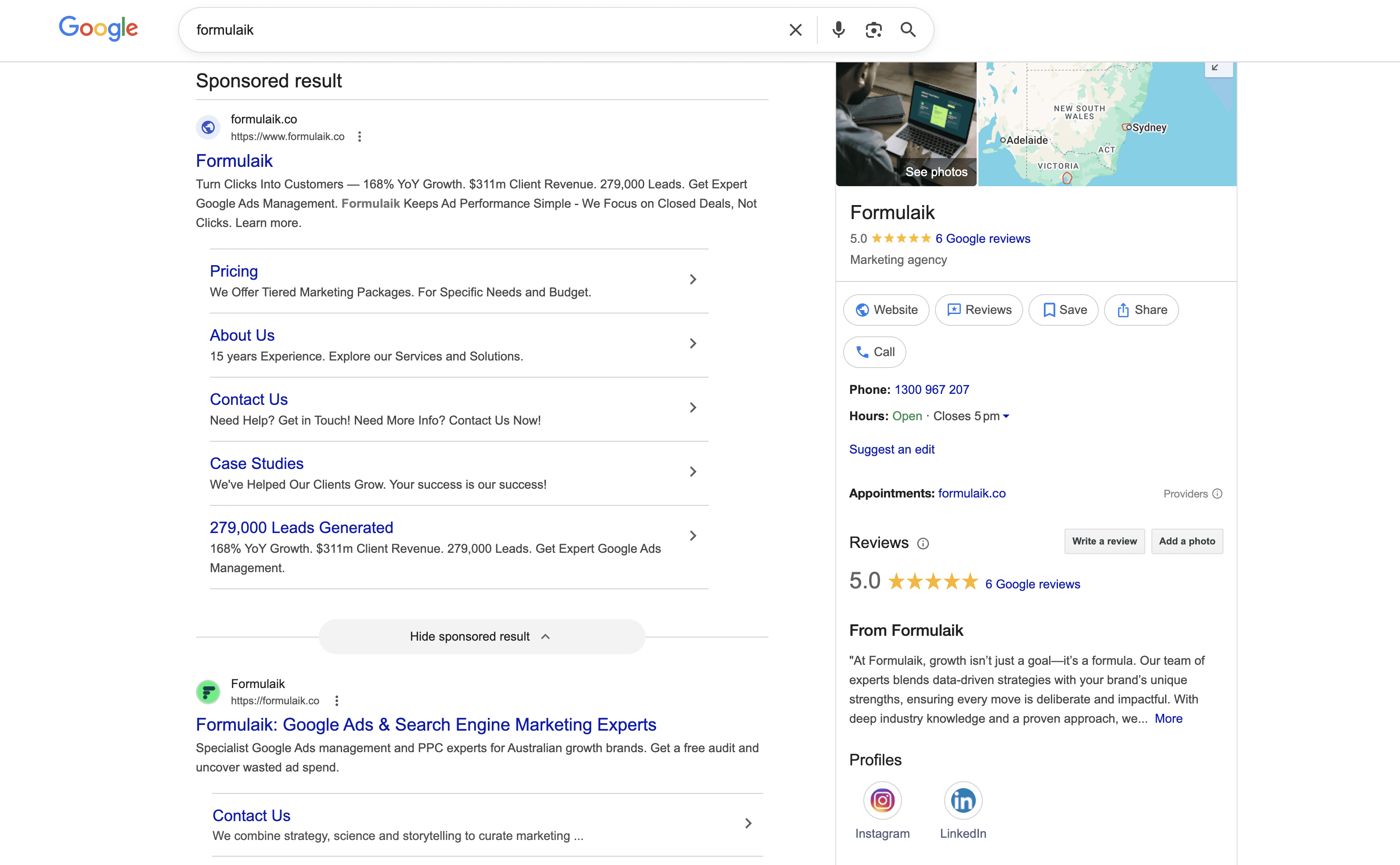
4. Bidding on branded terms you already own organically
This is one of the more nuanced sources of waste, and the right answer genuinely depends on your specific situation. But for many accounts, branded keyword spend represents budget that is producing conversions that would have happened anyway.
When someone types your business name into Google, they already know who you are. They have intent, brand recognition, and a destination in mind. In many cases, your organic listing will appear at the top of the results regardless of whether you're running a paid ad above it. Paying for a click you were going to get for free is, at minimum, worth examining.
The case for brand bidding is primarily defensive: preventing competitors from appearing above you for your own name, maintaining visual dominance on the results page, and capturing tracking data on branded searches. These are legitimate reasons. But they need to be weighed against the cost, and the decision should be deliberate rather than the default.
The question to ask is: if we turned off branded keywords for 30 days, what would actually happen to our lead volume and revenue? If the honest answer is 'probably not much,' the spend deserves scrutiny.
5. Weak or generic ad copy attracting the wrong clicks
Ad copy does two jobs, and most people only think about one of them. The job most people think about is attracting clicks. The job that matters more for lead-generation efficiency is repelling the wrong clicks.
Generic ad copy, the kind that describes your service in broadly positive terms without any specificity about who it's for, what it costs, or what the process involves, will attract a wide range of searchers. Some of those will be genuine prospects. Many will not. They clicked because the ad was vague enough to seem relevant, and they'll leave your landing page the moment they realise you're not what they were looking for. You've paid for that click either way.
Specific copy does the opposite. Mentioning a price range, a minimum engagement size, a service area, an industry specialisation, or a specific process filters the audience before the click happens. A searcher who reads 'Google Ads management for established businesses, from $2,000 per month' and still clicks is a more qualified prospect than one who clicked on 'Google Ads experts, get results today.' The first ad will have a lower click-through rate and a higher conversion rate. For lead generation, that trade-off is almost always worth making.
The same logic applies to your responsive search ad assets. If your headlines are interchangeable with any competitor in your category, they're not doing the filtering work they should be.
A quick copy audit you can run today |
Pull your top five ads by impression share. Read each headline and ask: could this ad have been written by any of our three closest competitors? If the answer is yes, the copy is not specific enough to attract the right clicks and repel the wrong ones. Look for opportunities to add specificity: price signals, qualifying language, industry focus, geography, or process details. |
6. Campaign structure so messy that budget bleeds across the wrong places
Campaign and ad group structure is the least glamorous aspect of Google Ads account management and possibly the most consequential. How an account is organised determines how budget flows, how bidding strategies learn, how quality scores accumulate, and how easy it is for a manager to identify and fix problems when they arise.
In a well-structured account, campaigns are organised around a clear logic: by service line, by geography, by funnel stage, or by audience type. Ad groups within each campaign are tightly themed, with keywords, ads, and landing pages that are genuinely aligned. Budget is allocated deliberately, with higher-value campaigns receiving proportionally more investment.
In a poorly structured account, the opposite is true. Campaigns that were set up quickly and expanded over time without a coherent plan. Ad groups containing dozens of loosely related keywords, with generic ads that aren't particularly relevant to any of them. Budget that flows to campaigns based on which ones happen to win auctions rather than which ones represent the best return. Quality scores that suffer because the keyword-ad-landing page alignment is weak, making every click more expensive than it should be.
The insidious thing about structural problems is that they don't show up clearly in headline metrics. An account can have a reasonable average CPL while individual campaigns are dramatically over or underperforming, because the average obscures what's happening underneath. Cleaning up structure is one of the highest-leverage things you can do in an account, and one of the hardest to do without breaking things in the process.
How to use this as a starting point
The six issues above are not exhaustive, but they cover the most common sources of pre-click waste we find across the accounts we audit. If you've read through this list and found yourself thinking 'we might have that problem,' you're probably right to investigate.
Some of this you can assess yourself. The search terms report review, the copy audit, and the branded keyword question can all be approached without deep technical knowledge of the platform. They require time and honesty more than expertise.
Other parts are harder to self-diagnose. Campaign structure problems in particular tend to be difficult to assess from inside an account, partly because the person who set it up often can't see its shortcomings, and partly because fixing structural issues without disrupting campaign learning periods requires experience with how Google's systems respond to change.
If you want an independent read on where your account sits, our audits are structured specifically to look at these issues across keyword strategy, match types, negative lists, structure, copy, and tracking. We'll tell you what we find and what we'd prioritise fixing, with no obligation to engage us to do it.