We have this conversation more often than you'd think. A business comes to us having spent several months running LinkedIn Ads, usually at the recommendation of their previous agency or their own LinkedIn account manager. The targeting looked compelling on paper. CFOs. Marketing Directors. Operations Managers at companies with 50 to 500 employees. Exactly the right people.
The cost per lead was $180. The sales team converted almost none of them. The agency's explanation was that LinkedIn takes time, that brand awareness was building, that the funnel needed more nurturing. After six months and a meaningful chunk of budget, the business had a tidy list of contacts who had clicked a form without any real intention to buy.
LinkedIn Ads are one of the more consistently oversold products in the paid media landscape, particularly for acquisition. The targeting capabilities are genuinely impressive. The intent signal is not. That distinction matters enormously for any business where the cost of acquiring a lead has to be justified by a realistic conversion rate and a sustainable cost per customer.
This is our honest assessment of why LinkedIn Ads underperform for most acquisition-focused campaigns, how the economics compare to Google Search, and the specific circumstances where LinkedIn can make sense.
The targeting is precise. The intent is not.
LinkedIn's pitch to advertisers has always centred on targeting quality. You can reach people by job title, seniority, company size, industry, skills, and even specific companies. For a B2B business trying to reach, say, heads of finance at mid-market professional services firms, the ability to filter that precisely is genuinely valuable.
The problem is that targeting precision and purchase intent are two different things, and LinkedIn conflates them in a way that's commercially convenient but analytically misleading.
When someone types 'commercial cleaning services Melbourne' into Google, they are telling you something specific about their state of mind. They are actively looking. The search itself is a signal of intent. You are reaching them at the moment the need is present.
When someone is scrolling LinkedIn, they are in a fundamentally different headspace. They're catching up on industry news, checking who viewed their profile, watching a video someone in their network shared, or idly browsing between meetings. They may be exactly the right person, with exactly the right job title, at exactly the right company. But they were not looking for your product. You have interrupted them, and the psychological distance between interruption and purchase decision is considerable.
This is the intent gap. It's not a flaw in LinkedIn's platform so much as a structural reality of how people use it. And it has a direct, measurable effect on conversion rates and cost per lead.
What the economics actually look like
LinkedIn's average cost per click in 2026 sits around $5.50 globally, though in competitive professional service categories and senior audience segments in Australia, $8 to $15 per click is common. Against that, the platform's own data and independent benchmarks consistently show click-through rates of around 0.5 per cent for sponsored content, with conversion rates on lead gen forms typically landing between 2 and 4 per cent.
Run those numbers and a cost per lead of $60 to $150 is the typical range across industries, with software, healthcare, and enterprise services regularly sitting above $150. That's before you factor in the quality of those leads and what proportion actually convert to sales conversations, let alone customers.
Compare that to Google Search. A well-managed Google Ads account targeting high-intent search queries in a B2B service category will typically produce cost per clicks in the $3 to $10 range, with conversion rates on a properly built landing page of 5 to 15 per cent. The economics are meaningfully different, and the key distinction is intent. Google captures demand. LinkedIn tries to create it.
LinkedIn Ads | Google Search Ads | |
User mindset | Professional browsing, passive | Actively searching, high intent |
Average CPC (AUS) | $8 to $15 for senior audiences | $3 to $10 depending on category |
Typical CTR | ~0.5% for sponsored content | 3 to 6% for well-structured campaigns |
Conversion rate | 2 to 4% via lead gen forms | 5 to 15% on optimised landing pages |
Typical CPL range | $60 to $150 or more | $30 to $100 depending on category |
Lead quality signal | Job title match, no active intent | Search query reveals active need |
Best use case | Brand, retargeting, ABM | Acquisition, lead generation |
Note on the comparison: These are indicative ranges based on industry benchmarks and our account experience, not guaranteed figures. Both platforms vary significantly by industry, audience, creative quality, and account structure. The point is the directional difference, not the exact numbers.
Resources used:
LinkedIn Ads benchmarks 2026 (The B2B House): theb2bhouse.com/linkedin-ad-benchmarks
LinkedIn Ads cost and pricing guide 2026: stackmatix.com/blog/how-much-linkedin-ads-cost
WordStream 2025 Google Ads Industry Benchmarks: wordstream.com/blog/2025-google-ads-benchmarks
The lead gen form problem
LinkedIn's native lead gen forms are frequently cited as a solution to the platform's conversion rate challenge. The forms pre-populate with a user's LinkedIn profile data, reducing friction, and they do convert at higher rates than sending users to an external landing page.
The issue is what you actually get at the end of the process. A contact who saw a sponsored post in their feed, found the offer interesting enough to tap through, saw their details were already filled in, and submitted the form with minimal effort. The friction reduction that improves form completion rates is the same friction reduction that captures contacts who were mildly curious rather than genuinely interested.
Sales teams working LinkedIn leads consistently report the same experience: lower response rates to follow-up, shorter and more noncommittal conversations, and lower conversion to qualified pipeline compared to leads from search. The lead looks good on the dashboard. It performs poorly in the real world.
This is not a verdict on LinkedIn as a platform. It's a structural observation about what low-friction, interruption-based lead capture produces, compared to someone who typed a specific query into Google and worked their way through a landing page to submit their details.
When LinkedIn Ads do make sense
Having made the case against LinkedIn for acquisition, it's worth being specific about the circumstances where we'd recommend it, because they exist.
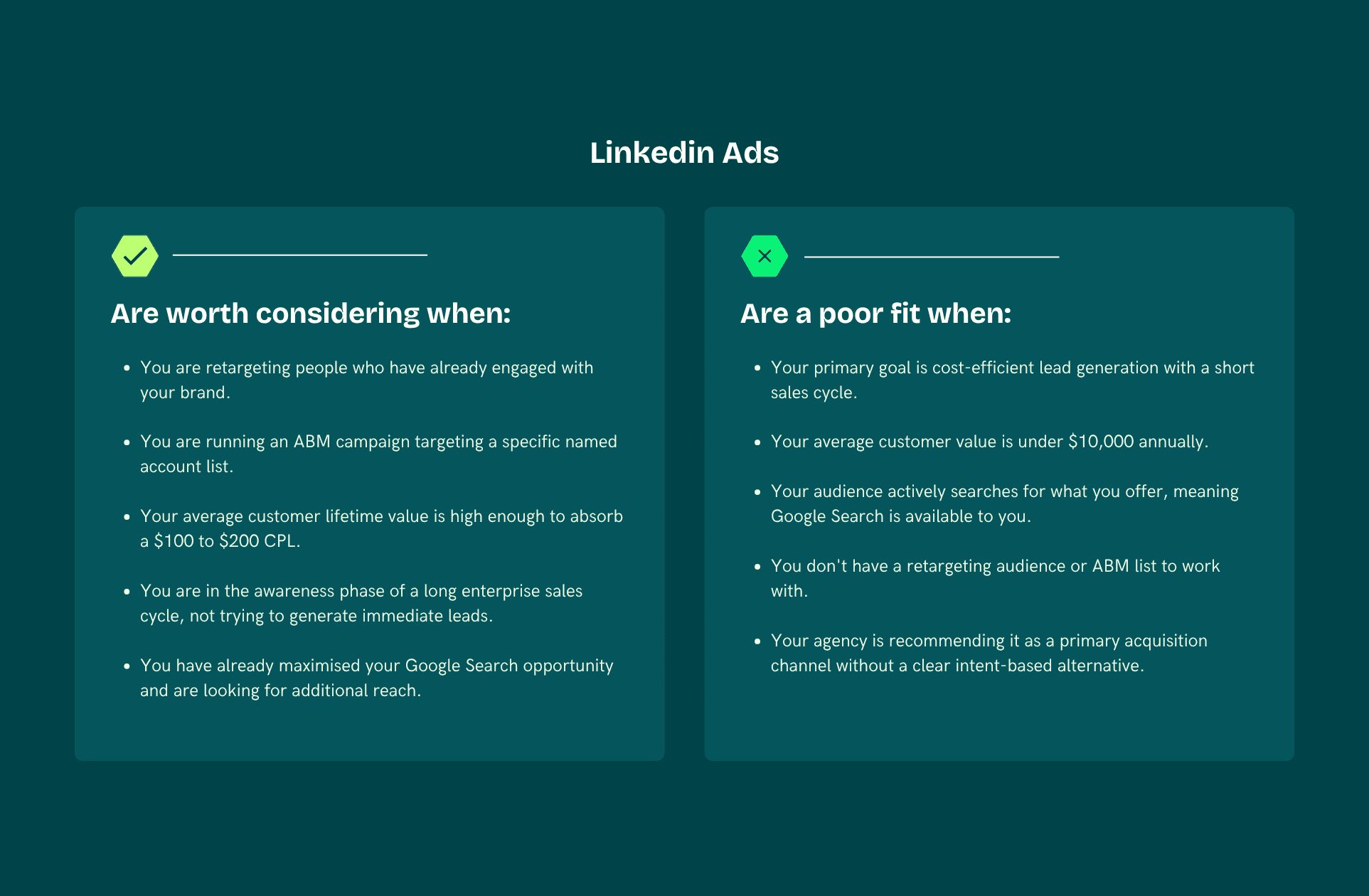
Brand awareness for enterprise B2B, where the sales cycle is long, the deal value is high, and multiple stakeholders are involved in the decision, can justify LinkedIn's premium costs. When a single customer is worth $200,000 a year, the arithmetic around a $150 CPL looks very different from a business where a customer is worth $5,000.
Account-based marketing campaigns targeting a specific named list of companies are another legitimate application. If your sales team is working a shortlist of 50 target accounts and you want to build brand recognition with the decision-makers at those companies before a sales conversation, LinkedIn is well-suited to that. The economics of ABM are different because you're not optimising for volume, you're optimising for presence with a defined group.
Retargeting warm audiences is the strongest use case. If someone has visited your website, watched a video, engaged with your content, or is already in your CRM, LinkedIn's ability to serve ads to those specific people in a professional context is genuinely useful. The intent signal problem largely disappears when the audience already knows who you are and has demonstrated some level of interest. Retargeting CPLs are also significantly lower than cold audience acquisition costs. However…we still see stronger results from Google PMAX campaigns with Meta retargeting.
The sales pitch versus the reality
Part of why this keeps happening is that LinkedIn sells its advertising very effectively. The targeting interface is genuinely impressive to look at. The ability to filter by job title, seniority, company size, and industry feels powerful, because it is. And LinkedIn account managers are well-trained to present case studies from enterprise software companies with nine-figure marketing budgets and 24-month sales cycles as evidence that the platform works for everyone.
It doesn't. And an agency recommending LinkedIn as a primary acquisition channel for a lead-generation business with a $15,000 monthly budget and a 30-day sales cycle is either not doing the channel analysis or is recommending what's easiest to sell rather than what's most likely to produce results.
The question any marketing manager should ask before committing budget to LinkedIn is simple: are my potential customers actively searching for what I offer? If the answer is yes, Google Search should almost certainly come first. LinkedIn, if it belongs in the mix at all, belongs as a complement to a search strategy that is already working, not a substitute for one.
Related: If you're unsure which channels make sense for your business and budget, our strategy sessions cover exactly this - Book a call with Formulaik
What to do with this
If LinkedIn is currently your primary paid acquisition channel and the leads aren't converting, the numbers above give you a framework for having a direct conversation with your agency. The question isn't whether LinkedIn can ever produce leads. It's whether it's the right place to spend acquisition budget given the intent gap, the cost structure, and what's available to you elsewhere.
If you have an existing Google Search presence that's working, LinkedIn retargeting off the back of that traffic is a reasonable next step. If you don't yet have a Google Search strategy that's performing, that's where the budget should go first.
We're happy to talk through channel mix with any business that's unsure whether their current spend is allocated in the right places. It's one of the more common things we cover in our initial audits, and it usually produces the clearest and most actionable recommendations.
Book a free audit or strategy call with Formulaik: formulaik.co/book-free-audit