We hear some version of the same conversation on almost every discovery call. A business owner or marketing manager tells us their cost per lead has gone up, sometimes significantly, over the past six to twelve months. They've already talked to their current agency about it. The agency said the market got more expensive. End of explanation.
Sometimes that's true. Google Ads costs have been rising consistently. The average cost per click across Australian industries climbed roughly 12 to 13 per cent year on year through 2025, and in competitive sectors like legal, finance, and home services, the pressure is steeper again. But blaming the market is often the easy answer, not the complete one.
In our experience, rising CPL usually has more than one cause. And at least some of those causes are within your control. Below is our honest breakdown of the four most common reasons CPL increases, what each one actually looks like, and what you can do about it.
1. Your landing page or offer is doing more damage than you think
Most businesses focus almost entirely on the ad side of their paid search account. Bids, keywords, match types, copy. These things matter. But the ad only gets someone to click. What happens after the click is where most CPL problems actually live.
A landing page that takes four seconds to load, a form that asks for eight fields when three would do, a headline that talks about your business rather than the customer's problem, a call to action that says 'submit' instead of something that signals what happens next. Any of these will quietly erode your conversion rate, and every drop in conversion rate is a corresponding rise in cost per lead.
The maths is straightforward. If you're paying $8 per click and converting at 10 per cent, your CPL is $80. Drop that conversion rate to 6 per cent and your CPL becomes $133, on the same budget, with the same ads, in the same market.
Similarly, the offer itself matters. If your competitors have updated their proposition and yours hasn't moved in two years, the market will tell you through lower conversion rates. This is particularly common in industries where a few aggressive players have shifted what buyers expect.
Questions to ask yourself |
|---|
When did you last test your landing page against an alternative? What is your landing page conversion rate, and how does it compare to six months ago? Has your core offer changed meaningfully in the past 12 months? Is your page mobile-optimised? Most lead-gen traffic now comes from mobile. |
2. Google's automation is optimising for volume, not quality
This is the one agencies rarely bring up, because pointing it out requires admitting that the platform they're running for you may be working against your actual goals.
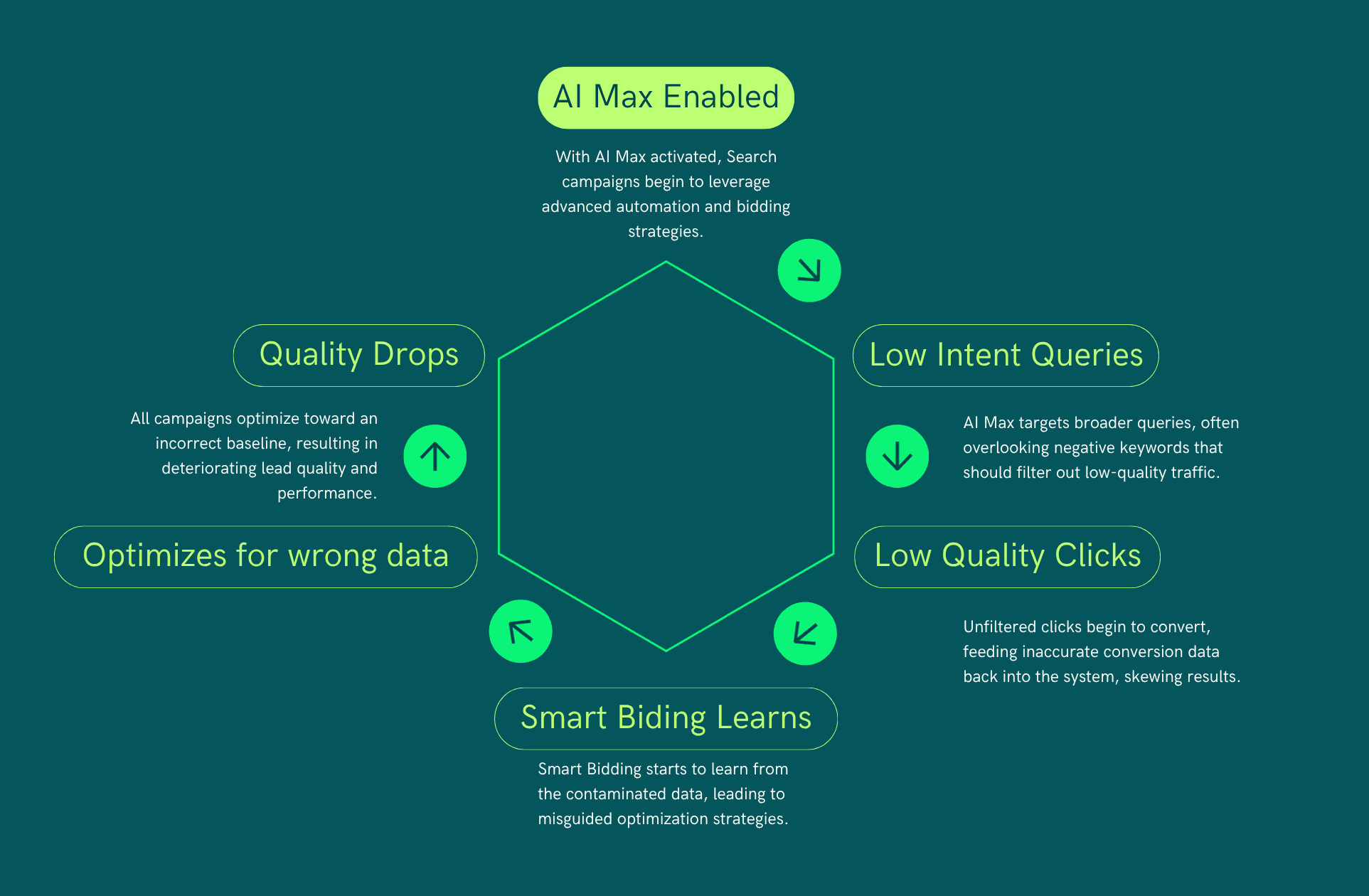
Google's automated bidding strategies, particularly Maximise Conversions and Target CPA, are powerful when they have clean, accurate data to learn from. When they don't, they optimise for whatever they can measure. And what they can measure is often not what you actually care about.
If your conversion tracking is set up to fire on a form submission, Google will work hard to get you form submissions. But if a significant portion of those form fills are low-intent, wrong-fit, or fraudulent, Google doesn't know that. It keeps sending you more of the same. Your lead volume looks fine in the dashboard. Your CPL looks manageable. But your sales team is working through a list of people who were never going to buy.
The fix requires connecting what happens after the lead to what the campaigns are optimising for. Enriching your conversion data with CRM signals, importing qualified lead or sales data back into Google, and building in negative signals for poor-quality conversions. Without this, you're essentially asking Google to drive more traffic to a leaky bucket and calling the result growth.
3. The market did get more expensive, and your agency should have told you that with data
To be fair to the market explanation: it is real. Australian search advertising revenue hit $8 billion in 2025 according to IAB Australia, growing more than 11 per cent year on year. More advertisers competing for the same keywords means higher auction prices. That is simply how the platform works.
The problem isn't that costs went up. The problem is when the response to rising costs is to accept them passively rather than adapt around them.
A rising cost environment is exactly when account structure, keyword strategy, and quality score work starts to pay dividends. Tightly grouped ad groups, highly relevant ads matched to specific search intent, landing pages that actually answer the query rather than generic service pages. All of this affects your quality score, which directly affects what you pay at auction relative to competitors. Two businesses bidding on the same keyword, one with a quality score of 4 and one with a quality score of 8, are paying significantly different prices for the same position.
If your agency's response to CPL going up has been to recommend increasing budget rather than improving the account, that is worth questioning.
Related: For context on what this kind of account-level work produces over time, the Wisr and Hub Australia case studies are worth checking out
4. Your attribution is broken, and you might be measuring the wrong thing entirely
This is the most uncomfortable one, because it means your CPL may have appeared to go up partly because you're now measuring it more accurately.
Attribution has become genuinely complicated. iOS privacy changes, Google's shift toward consent-based tracking, the deprecation of third-party cookies, and the rise of cross-device behaviour have all made it harder to reliably connect ad clicks to conversions. Many businesses are running on tracking setups that were configured years ago and haven't been updated.
What this produces is a situation where some conversions are being double-counted, some are being missed entirely, and the CPL figure you're looking at is a partial picture. We regularly audit accounts where the reported conversion volume looks reasonable but the underlying data is capturing form submissions on thank-you pages, phone calls from the wrong attribution window, and duplicate events firing from multiple tags.
Fixing attribution isn't glamorous work. But it is foundational. You can't make good decisions on bad data, and you definitely can't hold an agency accountable for results you can't accurately measure.
Signs your attribution may be unreliable |
|---|
Your reported leads don't match what's coming into your CRM or inbox. You're running Google Ads and Meta simultaneously with no cross-channel deduplication. Your conversion tracking hasn't been audited in the past 12 months. You're relying entirely on last-click attribution for a product or service with a longer decision cycle. Phone calls are either not tracked at all or tracked with a 90-day attribution window. |
What to do with all of this
The CPL conversation is rarely simple. In our experience, most accounts where CPL has risen meaningfully have at least two of these four problems operating simultaneously. The market cost issue is often real but is frequently overstated relative to the controllable issues sitting inside the account.
The starting point is an honest audit: conversion tracking, landing page performance, account structure, bid strategy health, and offer positioning. Not a five-minute review before a sales call, but a proper look at what is actually happening and why.
If you'd like us to do that for your account, we offer a free audit with no obligation to work with us. We'll tell you exactly what we find.
Book a free Google Ads audit with Formulaik: formulaik.co/book-free-audit